Monday, March 25, 2024

February 2024 TTRPG Crowdfunding Retrospective


Mashup of Backerkit, Crowdfundr, and Kickstarter logos reading: BACKfundER


For an overview of my methodology, please refer to my original November post. The only additions this month is tracking when campaigns begin and how long they run for.

As always, the raw data are available for you to peruse at your leisure.

The big picture statistics:
  • 232 campaigns
    • 12 Backerkit
    • 5 Crowdfundr
    • 215 Kickstarter
  • $3,374,090.03 raised
    • $884,266.93 on Backerkit
    • $20,109.28 on Crowdfundr
    • $2,469,713.82 on Kickstarter
  • Types of campaigns
    • 16 accessories
    • 47 adventures
    • 5 advice
    • 1 audiobook
    • 1 bundle
    • 4 campaign settings
    • 1 fundraising campaign
    • 78 supplements
    • 78 systems
    • 1 zine
  • 108 distinct systems used (55 original)
    • 54 campaigns (23.28%) used D&D 5E and raised $568,095.60 (16.84% of all money raised in February)
  • 35 campaigns featured AI (15.09% of total)
    • These campaigns raised $236,973.58 (7.02% of all money raised in February)
    • 21 of these were D&D 5E campaigns, accounting for 38.89% of all 5E crowdfunding campaigns

Kickstarter's February

The top 5 TTRPG campaigns were:
  1. Tales of the Valiant Game Master's Guide 5E by Kobold Press ($461,868 from 5711 backers)
  2. Vault 5e: Crafting & Alchemy by Cubicle 7 Games ($159,284.21 from 1973 backers)
  3. Tomb of a Thousand Doors: A Mausritter Megadungeon by Matthew Morris ($94,305 from 1336 backers)
  4. Battle for the Realm (5e) by Midnight Tower ($86,882.76 from 1371 backers)
  5. Level Up: A5E Gate Pass Gazette Annual 2023 by Morrus ($72,695.11 from 901 backers)
ZineQuest and ZineMonth always bring a mind-boggling amount of TTRPG projects to Kickstarter and 2024 was no exception. Three times as many campaigns ended in February as did in January, and that's with fewer days to actually work with. Interestingly, the average Kickstarter campaign raised about the same amount of money between the two months ($11,435.03 in January vs $11,487.04 in February) but the median amount was nearly $500 higher in January ($4,190.04 vs $3,701.65).

One effect that ZineQuest/Month may have had, though, is tamping down the higher-profile indie campaigns. As you can see, the top 5 campaigns in February are unusually D&D 5E heavy and also primarily from well-established companies in that sphere as well (Kobold Press, Cubicle 7 Game, Morrus). From completely anecdotal evidence, this is likely because larger indie creators tend to not launch campaigns during ZineQuest/Month to allow smaller creators better access to the money and energy that these events create.

Backerkit's February

The top 5 TTRPG campaigns were:
  1. The Covens of Midnight - A Tarot-Based GM-less RPG by Crossed Paths Press ($425,908.06 from 4504 backers)
  2. Memento Mori - A Roleplaying Game of Dreams and Corruption by Two Little Mice ($230,847.67 from 1630 backers)
  3. Can You See Them? A Scenario Book for the Horror RPG. by DMDave Publishing ($105,076 from 1095 backers)
  4. Punk is Dead - a Mörk Borg compatible songwriting TTRPG by Critical Kit Ltd ($91,416.03 from 1422 backers)
  5. Advanced Rules by RV Games ($7,781 from 295 backers)
Unfortunately we cannot make the same comparisons between January and February for Backerkit for two reasons: 1) there were only 4 campaigns in January; and 2) one of those campaigns was MCDM RPG. As such, the 'average' campaign in January raised $1,152,213.92, while the median campaign raised $3,777.61. Compare this to the average ($73,688.91) and median ($6,662.59) campaign in February. These are just not comparable numbers.

Most notable in February's numbers, I would say, is the vast gulf between the top 4 campaigns and everything else. Covens of Midnight and Memento Mori hold the distinction of being original systems with glossy production values, while Can You See Them? and Punk is Dead are both supplements for fairly popular systems (Year Zero Engine and Mörk Borg, respectively), but all 4 are operating in (or close to) the six-figure realm. This is several orders of magnitude higher than the fifth spot game, which is also a supplement for a very popular game (Mothership). I have to wonder if this is due to Backerkit's baffling ranking system, which seems to push already successful and popular campaigns to the top of the Tabletop/Role-Playing categories (sometimes even putting already finished campaigns above ones that are still running).

Crowdfundr's February

The top (and only) 5 TTRPG campaigns were:
  1. Return to Perinthos: A Memorial Book Fundraiser in the Memory of Jennell Jaquays by Violet Ballard ($11,590 from 277 backers)
  2. Making a Tabletop RPG for YOUR Particular Kid by TTRPGKids ($4,340 from 153 backers)
  3. ARKYVR by Alewood Games ($2,200 from 86 backers)
  4. The H.O.M.E. Handbook - A Tiny Supers Expansion by Gallant Knight Games ($1,852 from 114 backers)
  5. Glaive-Guisarme-Glaive: Historical-ish Wargaming by Chris Longhurst ($127.28 from 8 backers)
Crowdfundr is back babyyyyyyyy! And it even has enough successful campaigns to fill out a top 5! Unfortunately this is still a marked decrease from last year's Tabletop Nonstop event, which had 10 successful campaigns end in February. There's also a pretty steep dropoff from the top-performing campaign to the other four, and that's with the significant social media attention that Jennell Jaquays' unfortunate passing received in the broader TTRPG community. I really wish that Crowdfundr was performing better, as I have had a pretty good experience running campaigns on the platform, but I'm struggling to understand what exactly it's bringing to the table that would really entice people to choose it over Kickstarter or Backerkit.

ZineQuest/Month retrospective

In the big picture, what does the glut of TTRPG campaigns for ZineQuest/Month do for the space? Well, the main thing is the influx of creatives inspired to actually make something and crowdfund it, because the money surprisingly stays fairly consistent.

Across all platforms in January, the average campaign (excluding MCDM RPG) raised $11,079.28 and the median campaign (including MCDM RPG) raised $4,031.06. In contrast, across all platforms in February, the average campaign raised $14,543.49 and the median campaign raised $3,875.61.

Be aware that the x-axis is not spaced out proportionally

The stacked bar graph above shows that in both January and February, the vast majority of TTRPG campaigns raised $10,000 or less. Interestingly, the first four bins have an almost identical distribution of campaigns relative to the total for each month:
  • January (74 campaigns)
    • $0-$10,000: 56 (75.7%)
    • $10,001-$20,000: 9 (12.2%)
    • $20,001-$30,000: 3 (4.1%)
    • $30,001-$40,000: 1 (1.4%)
  • February (232 campaigns)
    • $0-$10,000: 177 (76.3%)
    • $10,001-$20,000: 26 (11.2%)
    • $20,001-$30,000: 9 (3.9%)
    • $30,001-$40,000: 4 (1.7%)
I certainly can't say anything qualitative about ZineQuest/Month, but quantitatively? It has an enormous impact on the money that enters the field, and crucially does not appreciably dilute the amount that any individual (successful) campaign sees.

Monday, February 5, 2024

January 2024 TTRPG Crowdfunding Retrospective

Mashup of Backerkit, Crowdfundr, and Kickstarter logos reading: BACKfundER

For an overview of my methodology, please refer to my original November post. The only additions this month is tracking when campaigns begin and how long they run for.

As always, the raw data are available for you to peruse at your leisure.

The big picture statistics:
  • 74 campaigns
    • 4 Backerkit
    • 0 Crowdfundr
    • 70 Kickstarter
  • $5,409,307.59 raised
    • $4,608,855.66 on Backerkit
    • $800,451.93 on Kickstarter
  • Types of campaigns
    • 6 accessories
    • 21 adventures
    • 4 campaign settings
    • 25 supplements
    • 14 systems
  • 27 distinct systems used (11 original)
    • 31 campaigns (41.89%) used D&D 5E and raised $363,665.69 (6.72% of all money raised in January)
  • 19 campaigns featured AI
    • 12 of these were D&D 5E campaigns, accounting for 38.71% of all 5E crowdfunding campaigns

Kickstarter's January

The top 5 TTRPG campaigns were:
Not the most promising start to the year for Kickstarter, especially after declining revenue from the tabletop category for the second year in a row. I highly recommend reading that article in whole, however, as it shows that there were more successfully funded projects this year than ever before (and that revenue from tabletop campaigns is still above what it was pre-pandemic). Take these trends with a grain of salt when applied to TTRPGs though, as it's almost definitely board games that really fuel the money in that field.

The main campaign of note from January is the physical Wayfinder Compass, which started at AU$135 (equivalent to about US$87.50 at the time of writing) and saw all 5 of its Deluxe Wayfinders (AU$1425/US$925) claimed. This kind of luxury item really sets the upper limit of what some hobbyists are willing to spend (living among the 3-book base set of D&D, scrolls of Fall of Magic/City of Winter, Monte Cook's infamous Black Cube, and the rewards offered from the MCDM RPG that will be discussed later in this post). If I may editorialize briefly, I don't really think these kinds of items are necessarily the best for the hobby as a whole (and this comes from someone who was recently gifted both Fall of Magic and City of Winter at my own request). High-priced luxury items are already status symbols of conspicuous consumption, and the more that this industry is pushed toward that level of production value the more smaller creators will get left behind. They also promote a sunk cost fallacy; having invested a considerable amount (both financially and emotionally) in a game, people might feel like they need to get the money's worth out of that game.

To be perfectly clear, I do not blame TYPE40 for wanting to make this product (though I might slightly blame people for backing it) or Heart of the Deernicorn for making their high quality scrolls. I'm simply identifying something that is already troubling as a trend in terms of the pressures it places on smaller artists/games.

Backerkit's January

This is an easy one, as there were only four campaigns in January:
Weird month for Backerkit. The MCDM RPG leaves everything else in the dust, helped in no small part by the $500 Ajax Edition of the game (all but 2 of the 1874 offered were claimed). But even those expensive options 'only' raised $937,000, meaning $3,663,520 was raised by roughly 28,303 other backers. As I said before, I feel deeply ambivalent/anxious about these luxury offers, but clearly this campaign did not need the luxury option to drive it to success. This game is going to really be the thing to watch as the campaign begins fulfilment. Will it prove a serious challenge to D&D or just be something of a flash in the pan? If I had to guess, I'd say that this is the beginning of another Paizo-esque challenger: an alternative to D&D that will have its set of devoted adherents but will claim a slice of market share several magnitudes smaller than D&D's.

Conclusions

It's hard to draw large conclusions from this set of data. I suspect that January is always a slow month just because people don't have much energy for running crowdfunding campaigns during the holidays and might be putting money into other places in their life. (Many assumptions going into this - that people live in a country that celebrates Christmas, that they celebrate Christmas, that this changes their behavior - but I think they hold up since Kickstarter is mostly a Western platform to begin with.) I don't feel like doing any graphs this month, but the next installment should be fascinating what with ZineQuest/ZineMonth happening.

Friday, January 19, 2024

Review: Cats Have No Lord double feature

A Tomb of Twins

Sometime mid-December, Luke Simonds posted on Bluesky asking if anyone was interested in reviewing two of his games (A Tomb of Twins and Won't Someone Think of the d100 Polearms?) as he had extra physical copies of them. I said I would, he sent them off, and now here we are about a month later.

Full disclosure: these reviews are based solely off reading the zines. I have not had the opportunity to put them into play, so interpret my opinions accordingly.

A Tomb of Twins

A Tomb of Twins is a 32-page (counting the covers) low-level dungeon zine for OSR games with writing and layout by Luke Simonds, art and map by Molomoot, and editing by Allison Miller Simonds.
 
A mysterious priesthood conducts monthly rituals inside the tomb of twin necromancers while rumors abound that great treasures and wealth is locked up inside. The twist is that the treasures in question (or at least the ones that the adventure hooks center around) are the phylacteries of the twin necromancers-turned-liches, while the monthly ritual keeps them from reforming and terrorizing the region.

The tomb itself is broadly twin-themed, with mirrored left and right sides of the dungeon presenting players a choice of where to go. A band of tunneling swampkin (blue humanoids who live in a nearby swamp) have entered one side of the tomb and pose an obstacle to the PC tomb robbers as well as a way to break up two otherwise identical routes.

From a design perspective, this adventure works well as an introduction to OSR-type play for new players. There's a dungeon, treasure, some inventive traps that can be circumvented with clever play, a puzzle, monstrous enemies, and a boss battle that can either be avoided or easily decimate the characters. Nothing here is really reinventing the wheel, but it also doesn't have to. The whole adventure could be completed in 1-2 sessions, and depending on how the crawl goes there is the potential for a number of further directions:
  • Accidentally release 1-2 liches
  • Make enemies/allies of the swampkin
  • Make enemies/allies of the Thieves Assembly or Arcane Academy for failing/succeeding to bring them the vials
My favorite part of the adventure has to be its take on the random encounter. The tomb traps spirits inside it, so it's positively full to bursting with ghosts. And not just ghosts of humanoids either, there's all sorts of ghostly vermin scurrying around to add a fun atmosphere to the whole thing. These vermin could pop up as random encounters, but more frequent an intelligent ghost will appear with their own motivation and information to share (or hoard). There are wizard ghosts who want to get to the center of the tomb with you, priests who want to keep you from advancing, and goblins who just want to cause pranks. This is a slight combination of the classic random encounter + reaction roll, but it works really well as a way to spice up the delve. You can't treat every ghost the same, and you have to approach them like any other NPC in order to suss out how they feel about you.

I have two primary critiques of the adventure. First, as I said above, it doesn't feel like it's doing much that's new. I know that I said it doesn't have to, and I stand by that, but there's a lot of design space that feels unexplored here. The two halves of the dungeon didn't have to be identical, for example. They could have been themed to each of the two necromancers, or have opposite versions of the other's traps/puzzles, or require various actions to be taken exactly simultaneously. I'm not trying to say "Well this is how I would have designed it," but the overall theming of the adventure just feels like it's begging to be taken one or two steps farther.

My second critique hinges on the swampkin. They add variety to the adventure, breaking into the left half of the tomb and keeping it from being exactly the same. This is fine, and two of the first swampkin you meet pose interesting roleplaying challenges. One is floating on the ceiling, having triggered an antigravity trap and willing to give information in return for help, and the other is described as kind-hearted and fascinated by humans. These are great moments but they're completely undercut by the bestiary's description of swampkin as "ruthless and indiscriminate killers." It just leaves a bad taste in my mouth to play into the portrayal of monstrous humanoids as intrinsically savage (perhaps not evil, but certainly violent and not prone to diplomacy). And the adventure itself doesn't bear this out! The two swampkin priestesses have opposing views on their expedition into the tomb, the warlord is insecure about his position and just wants a win to shore up support, and that one grunt just wants to get off the ceiling. The stereotypical "hyper-violent monstrous humanoids" just didn't need to be in the adventure at all and seems like an archaic holdover from early dungeon-crawling games. It would be more interesting to explore how both the swampkin and players are tomb robbers, and therefore have both a natural common cause and common conflict. This is already a sensibility reflected in the random ghost encounters, where the ghost is turned from a standard combat encounter with a monster into a variety of other things. Obviously nothing is stopping you from approaching the swampkin in the same way, but if that's the case I just don't understand the description in the bestiary. Much like my first point of critique, the swampkin feel like they're begging to be pushed just a little farther beyond the standard (and boring) 'savage' enemies.

If you're looking for a game to introduce players to the OSR, this is a fine choice. But if you're already familiar with the playstyle, I don't know how much will be here for you.

Won't Someone Think of the d100 Polearms?

Won't Someone Think of the d100 Polearms? is a 16-page (counting covers) system-neutral zine for crafting your own unique polearms with writing and layout by Luke Simonds, character illustrations by Evlyn Moreau, and editing by Allison Miller Simonds.

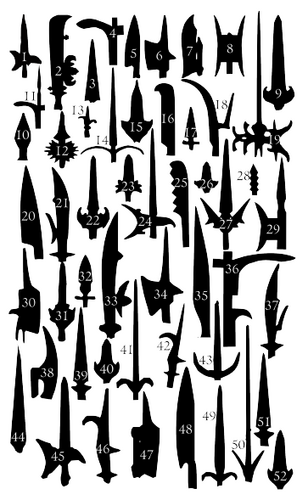
Quite simply, the whole zine is three d100 tables you can use to make 1,000,000 unique polearms. Granted, most of these variants are completely cosmetic (one table is for the design of the blade and one describes the decoration on the shaft), but don't knock the cosmetic elements of this zine. The blade design table is 100 silhouettes of polearm blades, all illustrated by Luke Simonds. If you scan these silhouettes onto a computer, it's an incredible resource for giving out polearms that players can see and get really attached to.
I know that I'd be more attached to something like 36 or 50 than the generic idea of a polearm.

The table describing the shaft's appearance is a little more repetitive (a lot of different colors, a lot of different inlaid items), but again, being able to grab some descriptive inspiration for a magic item is great.

But it's the "What Makes It Special?" table that really makes this zine, well, special. 100 (mostly) very different abilities, some good, some bad, some ludicrous, but all very different than a +1 polearm. For example, you could get a polearm where the blade functions like a camera, or the shaft turns into a ladder, or it smells really bad, or it gives you the ability to command stags (but they'll seek revenge afterwards). There's really something there for everyone and every type of game, from the serious to the comedic to the gonzo.

It's a good zine Bob!

Friday, January 12, 2024

Interview with ttrpgbrackets

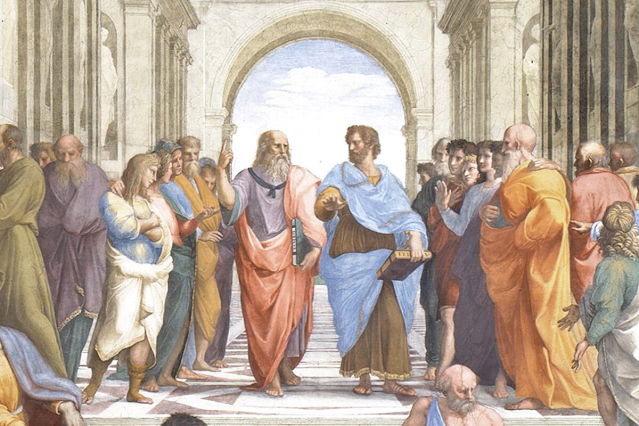
Section of Raphael's "The School of Athens": Greek philosophers (white men of varying ages in colored robes) in deep conversation

Recently, a very cool project on tumblr reached its conclusion: the TTRPG Ability Bracket (won by "Survivor Final Ability" from Shxll Casxings by Legendary Vermin). I thought it would be interesting to interview the person behind this project, see what inspired it, and ask about their plans for the future. What follows is that interview (edited and condensed for space).
__________________________________________________________________________

ttrpgspider: Let’s jump right into it! I’m trying to think, I don’t remember when I even first saw the blog on tumblr, but can you tell me a little bit about when you had the idea for it, when you started it, what the whole timeline of it has been?

ttrpgbrackets: You know what, I can actually give you an exact day because I messaged a friend and said, “I have this idea.” Looks like it would’ve been late September when I came up with this idea. I started bouncing things around in my head, and I believe it was mid-October or so when I launched it because I know I started doing the polls in November.


For people who have no idea what this was, what was the TTRPG ability bracket? What was the point of it, what was the structure of it?

To be completely honest, I didn’t expect it to get the attention it did. Once the authors of the games involved started reblogging things, I was like: Whoa. It kinda spun out of the current tumblr zeitgeist of fun little popularity brackets. There are a million of them right now: best villain song in a musical, best duo, best little meow-meow who did nothing wrong. And then it hit me that I was seeing some about cartoons and video games but none about TTRPGs. So I started thinking, what would I like that bracket to be about?


And how did you decide on abilities specifically?

Part of it was that I wanted to submit something that wouldn’t have fit my original idea of “TTRPG classes.” When I was thinking about what I would submit, I really love a lot of games that don’t really have classes. And specifically, one of my favorite games I was thinking about was Exalted, which has some of the most insane abilities that I personally knew at the time. And I was like, I bet there are a million games out there like Exalted and I want to know more of those.


So how did you go about collecting submissions?

I submitted the first couple, just because once I made it I had five or six I wanted to throw in there. And then towards the end, submissions started to peter out and I realized I was about 8 short of another tier. So I did another 8 or 9 myself and the rest were submitted through a Google Form that I threw up when I started the bracket. It was just a post that said “Hey, here’s some guidelines on things I do and don’t want to see in here,” and a little bit of rules about how I was going to be selecting things if I did have to cut stuff. Mainly I had a rule that I didn’t want more than two abilities per game.


Beyond cutting - well, even with cutting the stuff from the popular games - how did you go about making decisions? Both which 2 abilities you kept in and how you decided on the brackets?

I’m going to be completely honest and say that I didn’t put that much thought into the seeding portion of it. Once I had the entries in, I just randomized the seed until nothing was going against itself in Round 1 and that was good enough for me. But as far as cutting things down, I didn’t have to do a lot of that. I think I only ended up cutting maybe 5 things total. I got 3 submissions from Pathfinder, and I got 12 different people submitting things for Lancer. But that was kinda easy because 8 of them submitted the same ability so that was a shoo-in.


Do you remember what ability that was?

Castigate the Enemies of the Godhead. It’s a Manticore ability where you basically declare “Until the end of the round if anything kills me I vaporize my mech and everything in a 30-yard radius.” Then there were two others where 3 or 4 people submitted each one. It was either Ushabti Omnigun or the other one that’s on the Pegasus, and for that one I just went with whatever was the most elegant or eloquent propaganda that was submitted with it.


Tell me a little bit more about the “propaganda,” which is such a funny way to talk about that.

Full disclosure, I follow a lot of these bracket-type things and most of them refer to any kind of - if anyone reblogs it with “hey, here’s why you should vote for this one,” they’ll reblog it and say “look, propaganda.” I felt like it was especially important for something rpg-related to have that aspect of it. Especially with indie TTRPG abilities, you might not understand what’s so cool about the ability if you don’t know the context of the game it’s from.


Yeah, I was scrolling through the blog and saw “Man with a Gun” from Spire, and it’s not just ‘a man with a gun comes into the room,’ it’s ‘you’re a pulp novelist wizard writing tropes into reality.’

Yeah, it gets you that context of “Oh, this is a weird thing.” You don’t just have a friend that shows up, you’re messing with reality.


Now I’m going to declare you a minor expert in minor TTRPG abilities - 

Appreciate it.

- and as such what do you think (personally or based on observed voting trends) makes a good TTRPG ability?

At least in terms of what makes it interesting (as opposed to what makes it powerful), the ones that did the best were the ones that pushed the fiction forward the most. All of the ones that gave a +2 to doing something got buried out behind the shed very quickly. Most that made it past the second round did something special within the world of the game.

For example, there’s this Pathfinder ability that essentially lets you say, “Well I’m not a doctor but I’ve seen one on TV” and once a day you get to pick an ability from another class that you can use for the day. Like, “I may not be a barbarian but I can figure out how to rage.” And that ability made it to round 2 or 3.

The Omnigun from Lancer also made it pretty far, which is funny because it’s just a gun that automatically does one damage every turn. But it was the wording of the book that got it that far. Its gimmick is that it always deals one damage no matter what, armor-piercing, can’t be dodged, but there’s a line that a lot of people seemed to like. It ends with the line “This cannot be superseded by any ability in this or any future book.”


Yeah, it’s interesting because when I think about TTRPG abilities (and obviously not every game has them), I think about D&D, Pathfinder, Lancer, those kinda crunchy, trad, modular games. And yeah, they have so many abilities, but by that same logic they can’t be as interesting or impactful and, say, give someone something entirely new they couldn’t do before.

I think that’s why we got so many submissions from PBTA and Forged in the Dark games. You get three things to do in those games, so they all need to be really cool. There’s no room in the book for a +1.


You don’t advance very quickly or that much, and even when you do advance you don’t take that many new moves.

A lot of characters in those games are in their final form at the start of the game. You’ve already hit that fantasy!

A lot of indie games also emphasize shorter campaigns, they’re not assuming the big 4-year Lord of the Rings campaign. You sit down, you make characters, and you play one season of a TV show. With how much a lot of these games lean into genre, a lot of these moves are very much, “Yeah, this is a thing I’ve seen in that show before.” One of the moves that made it a little farther was Beam Saber, one of the more anime dramatic Gundam mecha rather than something super tactical, was an ability that gave you bonus dice if you reveal a dramatic secret to someone and immediately use it against them.


Having done this whole bracket, how important are abilities in terms of what you’re looking for in a game?

Personally, I love them. I enjoy a good Honey Heist, but I like looking through abilities and seeing what pushes my character in a specific way. They’re not necessarily required for a good game, but I find they do a lot in games with more mechanics or character options. Having these unique abilities, especially with newer players, helps them see what their character can be, what they can do. I’ve often found with newer players that introducing them into a game they’ve never played a lot of times the big question is “Ok, but what can I do? My character has 3 Strength and 2 Charisma, what does that mean?” Sometimes players like to have the direction of, “Oh, that’s what I do! That’s my thing!” Even something as simple as getting a +1 in a particular situation encourages you to put yourself in that situation, to build a character who would want to do that.


Alright, I think that basically wraps it up! Last question: what’s next for ttrpgbrackets?

Right now submissions are open for the TTRPG class bracket. Any kind of character archetypes or classes or suggested builds are an option. Depending on how many I get, that could take a couple of months, I like to leave them up for a while to get votes in. After that, I might go back to another round of abilities and just disqualify anything that made it past round 3 because I got a lot of message toward the end of people saying they would have submitted or voted for something. I’ve also thought about setting up something for board games because I’m a big fan of those and I think there’s a lot of crossover there.

__________________________________________________________________________

If you're interested in submitting something to the TTRPG Class Bracket, you can do so here.

Monday, January 8, 2024

December 2023 TTRPG Crowdfunding Retrospective

Mashup of Backerkit, Crowdfundr, and Kickstarter logos reading: BACKfundER


For an overview of my methodology, please refer to my original
November post. The only addition this month is tracking what campaigns feature AI.

As always, the raw data are available for you to peruse at your leisure.

The big picture statistics:

  • 119 campaigns
    • 7 Backerkit
    • 0 Crowdfundr
    • 112 Kickstarter
  • $3,178,874.35 raised
    • $116,631.00 on Backerkit
    • $3,062,243.35 on Kickstarter
  • Types of campaigns
    • 9 accessories
    • 40 adventures
    • 10 campaign settings
    • 35 supplements
    • 24 systems
  • 24 distinct systems used
    • 48 campaigns (40.34%) used D&D 5E and raised $999,475.20 (31.44% of all money raised in December)
  • 32 campaigns featured AI
    • 24 of these were D&D 5E campaigns, accounting for 50% of all 5E crowdfunding campaigns

Kickstarter's December

The top 5 TTRPG campaigns were:
Overall, an interesting bunch of highly successful campaigns! Still largely dominated by D&D (outperforms the next best by over $200,000) and sequels to preexisting games/products (I'm including Knock! Issue 4 here), but this is more or less to be expected. The most interesting factor here is the big dip in money ($9,018,619.50 vs $3,062,243.35) and campaigns (164 vs 112) from November to December. I'm inclined to attribute this to holiday fatigue (as I certainly wouldn't really want to be running a campaign in the leadup to Christmas) and money being spent in other places (such as on gifts for family/friends), but these are complete speculation.

Backerkit's December

The top 3 TTRPG campaigns were:
HUGE dropoff in money ($1,256,857.98 vs $116,631.00) but not in campaigns (10 vs 7) between November and December. None of the 3 campaigns mentioned above would have cracked the top half of last month's campaigns. This time around, it seems like there's a lack of big company names (Possum Creek and Bully Pulpit are big for indies, but don't compare to Monte Cook or Goodman Games) to drive traffic and money to Backerkit.

Crowdfundr's December

Literally nothing. Probably won't be much until Zine Month 2024/Tabletop Nonstop in February. Time will tell if Crowdfundr will become any kind of major player in this space.

Graph Time

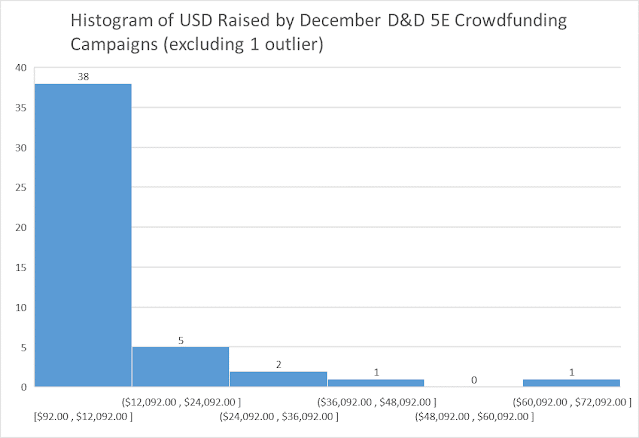
Once again, we must ask: is D&D 5E a sure bet? The average money raised by a 5E campaign in December 2023 was $2934.00, not far off from the median value of $2868.75. Once again, there was a big outlier campaign so I'm excluding that from the jump. 

Histogram showing the following distribution: 38 units in the $92-$12092 range, 5 units in the $12092-$24092 range, 2 units in the $24092-$36092 range, 1 unit in the $36092-$48092 range, and 1 unit in the $60092-$70092 range

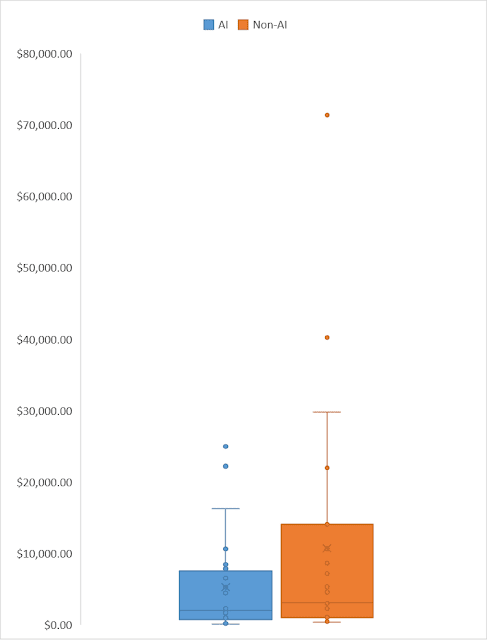
But the bigger question I have is: does using AI have a significant impact on the results?

Bar and whisker plot with 2 bars. The left bar has a lower average and lower upper bound than the right bar, as well as outliers with less value

This graph shows the difference in money raised between the groups of 5E campaigns using AI vs not (once again, the most successful campaign has been removed for ease of visualization, but the statistics are calculated still involving it). The average AI campaign raised $5,226.51 while the average non-AI campaign raised $36,418.29 ($10,708.13 without the most successful campaign). But even with the most successful campaign included, there is not a significant difference between the two averages (two-tail paired t-test p-value was 0.224, way over the significance cut-off of 0.05), meaning that we can't say for sure whether AI helps or hurts a 5E campaign.


No big takeaways this month, but stay tuned for a big 2023 retrospective.

Friday, December 22, 2023

A Modest Literary Analysis of "Use of AI" Sections on TTRPG Kickstarters, Part 1

As you are no doubt aware, the use of AI-generated content in TTRPGs is increasing. I was unfortunately reminded of this fact by @Ettin64, one of the creators of the fantastic Hard Wired Island.

The associated reddit post contains 13 links to DTRPG pages, of which about half have been delisted at the time of writing, and 4 links to completed Kickstarter campaigns that declare they have used AI.

I decided to revisit my November crowdfunding stats as well as my ongoing December crowdfunding stats to see exactly who is using AI and how. The full stats will come later (around the beginning of January), but right now I, like Ettin, am interested in the rhetoric these campaigns are using to talk about their use of AI.

Just so that we're all on the same page here, this is what Kickstarter has to say about using AI in projects on their platform:

Projects using AI tools to generate images, text, or other output must be:

  • Open and Honest: Disclose in your submission and on your project page
    • what AI technology you plan to use in creating your work 
    • how you plan to incorporate the AI-produced content in your project

AND

  • Original and Creative: Disclose in your submission and on your project page
    • the extent to which your project is your original work, and 
    • the specific elements you will be creating using AI output

Seems simple enough. So let's see some of the examples of this in action.

Standard Fare

First up is the standard stuff. I won't link any specific campaigns here, suffice it to say that it boils down to "We used Midjourney. We have a license to use Midjourney images." (Substitute Midjourney for whatever AI image creation was actually used). There's not much to say here. It's simple, it's to the point, it fundamentally misunderstands the question that they're allegedly trying to answer:

Do you have the consent of owners of the works that were (or will be) used to produce the AI generated portion of your projects? Please explain.

Almost by definition, artists whose work has been used to train these LLMs cannot consent because the training data is scraped from the internet. The one exception seems to be Adobe Firefly, which they claim is only trained on Adobe Stock and public domain images.

The question of credit raises its thorny head again in the next category of answers...

In the Current State of AI

Several campaigns use shockingly similar language (well not that shocking, two of those campaigns come from the same creator):

In the current state of AI we do not think there is a way that you can credit, but if such a thing occurs in the future we will be sure to implement it. 

Notice the use of "we think" and "if such a thing occurs in the future," creating a rhetoric of plausible deniability. "Well gee, we recognize that this is stealing from artists, but unfortunately there's just no way to get around it. Aw shucks, well if we can steal more ethically in the future we'll be sure to do that."

These campaigns also have identical answers to what parts of their campaign will use AI:
For the illustration of the pages we are using Midjourney, then use Photoshop to edit the illustration for the desired result.

So they're using Midjourney, but human labor is entering the picture to get the "desired result." If I had to speculate, this labor involves mostly eliminating the telltale signs of AI-generated art, but I will grant that there could be other goals here. Speaking of other goals...

Our Artistic Vision

One creator, Mizo Games, has a fascinating take on why they use AI art in all three of their campaigns:

The art generated for this project was created using Midjourney AI exclusively in response to our own unique prompts and direction. We did not use any pre-existing prompts or works from other Midjourney users as the basis for our art. While Midjourney's algorithm inherently draws on its training data, we made original creative decisions in iteratively guiding the AI output through descriptive prompting and deliberate selection. The resulting images reflect our artistic vision and choices alone.

There is a strong focus on "artistic vision" here, a real attempt to show ownership of the generated art by tracing its creativity through their human brains. Interestingly, they show more concern for the property and creative license of "other Midjourney users" than the artists whose work was used as training data in the algorithm. By focusing on how "unique" their prompts are, they seem to feel they can claim artistic legitimacy, ignoring presumably that anyone could use those same prompts and achieve exactly the same results. Still, this presents a fascinating rhetorical turn by virtue of recognizing that there is some illegitimacy tainting the use of AI-generation. If there weren't, there would be no need to defend it this way. Artists don't generally feel the need to disclose that their art was produced by their own unique thoughts and actions, as it's generally understood to simply be true. When it isn't (plagiarism, tracing, clear inspiration that isn't credited), people tend to take notice.

This concern about artistic legitimacy takes on a new form in the next category...

Specifically Not Writing

Too many campaigns to count have some variation of the following in their Use of AI section:

Covers are made with AI. All interior art is made by artists. No AI was used for writing any of the encounters, rules or any part of the product itself.

This one in particular is fascinating as it seems to admit that only humans can be artists (making AI what exactly?). But it's the latter half that bears closer inspection. "No AI was used for writing any of the encounters, rules or any part of the product itself." Well, if it's good enough for cover art, why is it not good enough for the writing? It appears to be almost a recognition that AI generation of writing in a TTRPG project would be illegitimate. The many campaigns that have some version of this all betray the same fundamental concern: that use of AI will render their products corrupted in some way. And while Mizo Games wrapped their use of AI into their overall creative vision, these other creators have instead divorced visual art from their TTRPG product. By separating visual art (cover or otherwise) from the writing, they are creating two categories of creativity in TTRPGs: the core (writing, pure creativity that cannot be touched by AI) and the periphery (visual art, incidental concerns that can be tainted by association with AI because they won't affect the perception of the core material).

Next time

 And with that, I'll leave the rest of the categories for next time. These are:

  • Stretch Goals
  • The Economics
  • Outliers
As a final note, there is a small category of campaigns that report using AI tools like Grammarly to polish their writing. I don't know where I personally stand on this, except to say that a human editor is going to be able to do that job much better. On some level, I commend those campaigns for disclosing that information in the first place as it is certainly nowhere near the level of AI use that these other ones are.

Wednesday, December 13, 2023

A System of Deliberate Violence

When attacking someone, gain +1 or -1 to the attack roll (your choice) for every applicable item from the following list:

  • You know their first name
  • You know their last name
  • You know their parents' names
  • You know their partner's/partners' name(s)
  • You have mutual friends
  • You have drawn their blood before
  • You have killed one of their species before
  • You studied their movements
  • You studied their anatomy
  • You had sex with them
  • You lived with them
For every applicable item, regardless of the effect on the attack roll, gain +1 damage.

Tuesday, December 5, 2023

November 2023 TTRPG Crowdfunding Retrospective

Mashup of Backerkit, Crowdfundr, and Kickstarter logos reading: BACKfundER


I recently became curious about the state of TTRPG crowdfunding (full transparency, it's partially because I am gearing up for a ZineMonth 2024 project *shameless plug*). How much money is actually being made? Who's making it? What are they making? And how many people are backing?

I know that this information is tracked for ZiMo by a variety of people (scroll down for the credits), but what about the rest of the year? What about bigger projects?

Essentially: what about the real money being made?

So because I am deeply unwell, I decided to take this project upon myself and start to keep a record of all the TTRPG crowdfunding campaigns I could find. To keep this work mildly manageable, I used the following criteria to filter through projects:

  1. I compared campaigns across three platforms: Kickstarter, Crowdfundr, and Backerkit. Kickstarter is the most obvious as it remains THE crowdfunding platform (despite announcing a pivot to blockchain technology in late 2021, followed by public outcry and decline in TTRPG project revenue in 2022, and a seeming retreat from the controversial technology in 2023), but Backerkit is giving Kickstarter a run for its money, having started its own crowdfunding operation in mid-2022. Crowdfundr is the odd one out in this pack, a smaller site that launched in 2022 as part of the ConnectionPoint family of crowdfunding websites, but it's the platform that I personally have used and it has a dedicated event called Tabletop Nonstop that coincides with ZiMo/ZineQuest in February.
  2. I limited myself to successful campaigns that ended during the month of November, with the goal being to see what is actually getting funding and where money is going. It would be interesting to see what kinds of projects don't get funded, but I don't want to draw attention to things that could potentially embarrass their creators. I know that I wouldn't want some random person on the internet pulling up things that didn't work out for me for the world to see (except for when I mastered out of a PhD program - I'll gladly talk about that anytime and highly recommend it to anyone).
  3. NO DICE/MINIATURES CAMPAIGNS. This is completely a personal choice, but I just did not want to sift through all of them. There were too many, and I don't consider them important to my goal. This does not, however, exclude campaigns for physical/digital accessories directly related to playing TTRPGs (things like character sheets, virtual tabletop platforms, etc.).
  4. I converted non-USD units into USD using the conversion rate on whatever given day I recorded the campaign. Does this accurately reflect the exact amount of money raised? Absolutely not. If you want to look up the conversion rate for the day that a campaign ended and fix my numbers, be my guest.
With all that said, witness the fruits of my labors.

Some big picture statistics for the state of November 2023 TTRPG crowdfunding:
  • 175 campaigns
    • 10 Backerkit
    • 1 Crowdfundr
    • 164 Kickstarter
  • $10,275,932.48 raised
    • $1,256,857.98 on Backerkit
    • $455.00 on Crowdfundr
    • $9,018,619.50 on Kickstarter
  • Types of campaigns
    • 7 accessories
    • 2 Actual Play shows
    • 41 adventures
    • 2 advice books
    • 8 campaign settings
    • 1 magazine
    • 58 supplements/expansions
    • 56 systems
  • 39 distinct systems used across all campaigns
    • 66 campaigns (37.71%) used D&D 5e and raised $5,621,468.60 (54.71% of all money raised in November)
    • 43 campaigns (24.57%) developed original systems and raised $751,587.43 (7.31% of all money raised in November)
But now let's dig a little deeper into some more interesting stats, starting with Backerkit.

Kickstarter's November

The top 5 TTRPG campaigns on Kickstarter in November are as follows:
If we take out D&D 5e campaigns, we're left with a top 5 of:
What can we learn from these two related top 5s? Two things: first, that D&D 5e still reigns supreme in the Kickstarter ecosystem (accounting for 62% of the money raised in November); second, reprints are the best bet for non-5e crowdfunding (accounting for three of the top five non-5e campaigns - TMNT, ACKS, Deadlands 25th Anniversary).

Backerkit's November

Of the 10 successful TTRPG campaigns in November on Backerkit, the most successful was either Monte Cook Games' reprint of Invisible Sun's Black Cube (raised the most money at $665,980) or Goodman Games' reprint of Grimtooth's Old-School Traps for 5e and DCC, which raised less money at $203,426 but had the most backers (3608) and surpassed their goal by the highest percentage (2,034% funded - goal of $10,000). The third most successful campaign was Evil Hat's Deathmatch Island (raised $161,870 from 3111 backers, 540% funded), a game based on the PARAGON system by John Harper.

While there were other successful campaigns in the $50,000-$75,000 range, these top three are the most interesting to me as they are most similar to the successful campaigns on Kickstarter: reprints, driven by established companies, large books full of art that only entities with considerable extant capital can produce. Those three campaigns alone account for 82% of the money raised on Backerkit in November.

Crowdfundr's November

There was only 1 TTRPG campaign on Crowdfundr in November: GVW: A Mork Borg Hardcore Wrestling Zine! by Gallant Knight Games. It was the only one to feature on the platform since the end of September. There's not much to say here, except to note that there have been just 40 TTRPG campaigns on Crowdfundr compared to Backerkit's 53 and Kickstarter's who-knows-how-many (there have been 99 campaigns that made over $100,000 in 2023 alone). Crowdfundr has a ways to go if it wants to compete in this particular arena, even despite its Tabletop Nonstop promotional event.

Big Conclusions

I want to drill down into a very important question - how sure of a bet is 5e? The average amount of money raised across all three platforms (well really two since Crowdfundr didn't have any 5e campaigns) for a D&D 5e-based campaign in November was $85,173.77.But Crooked Moon is an enormous outlier. Just take a look at this histogram:

A histogram with the following distribution: 65 units in the $174-$430,174 range and 1 unit in the $3,870,174-$4,300,174 range

Crooked Moon skews the data so much that it creates a category all its own. So what happens when we take it out?

Histogram with the following distribution: 55 units in the $174-$43,174 range; 4 units in the $43,174-$86,174 range; 2 units in the $86,174-$129,174 range; 2 units in the $129,174-$172,174 range; and 2 units in the $215,174-$258,174 range

The average becomes $24,634.38, and there are still two outliers that skew the data. Remove them and:
Histogram with the following distribution: 51 units in the $174-$28,174 range; 6 units in the $28,174-$56,174 range; 2 units in the $56,174-$84,174 range; and 4 units in the $112,174-$140,174 range

The data look practically the same, with a new average of $17,372.06. This is because the median value of a November 5e crowdfunding campaign is $4,026.84. Half of all campaigns (33 in total) made $4,000 or less, and if you take out the top three the median sinks to $3,671.56. Now this is nothing to sneeze at - hell, my own crowdfunding campaign in February made juuuuuust under $600 - but it's a far cry from a surefire runaway success. Indeed, the saturation of the market with 5e products probably helps depress the overall success of those same campaigns. Half of them aren't even appreciably more successful than system neutral/agnostic campaigns (average value: $10,117.02; median value: $3,392).

Takeaways

There's money in the TTRPG space. No reasonable person can claim that there isn't. The problem is that the space is awash in projects using D&D 5e and made by larger indie publishers, and also it's locked up in platforms like Kickstarter that aren't accessible to most people outside of North America and Western Europe. How do we fix this?

I have no idea.

Until a better answer comes along, I plan on continuing to catalogue TTRPG crowdfunding campaigns. Someone should keep an eye on them after all, and it may as well be me.

June 2026 TTRPG Crowdfunding Retrospective

It's still July, so this isn't yet completely 100% late. That's a win in my book, so check out the raw data and dive in. June 2...