Showing posts with label critique. Show all posts

Saturday, May 11, 2024

It's (Not) Dangerous to Go Alone: Death of the Author

Welcome to the (much delayed) second entry in It's (Not) Dangerous To Go Alone, my ongoing series about playing and critiquing solo TTRPGs!
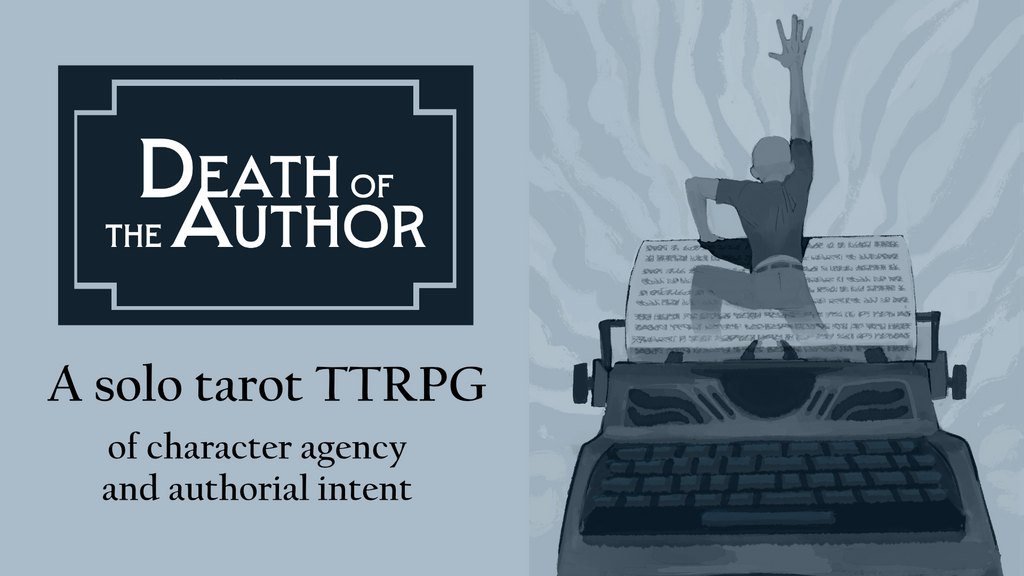
 A person crawling out of a typewriter, their hand outstretched. Text on the image reads: "Death of the Author; A solo tarot TTRPG of character agency and authorial intent"

When Samantha Leigh reached out to ask if I wanted to review their latest game, Death of the Author, I was an immediate and enthusiastic yes. I love solo games, I really admire Samantha's work, and the premise of the game was fascinating: a game about "a Character who attempts to gain control over their story, despite the wishes of their Author." Compelling stuff!

So I sat down with a Necronomicon deck of tarot cards that a friend gave me this past Christmas and about an hour later I had played through all five chapters of the game. I created a Character so obsessed with avoiding death that they began manipulating cancer cells to achieve eternal life, a Friend who betrayed me after seeing what I planned to do to their ailing great-uncle, and a Foe who tried to stall my research in undergrad and continued to stalk me even after their initial failure.

But the most interesting outcome was how the confrontation with the Author went. Throughout the game, your Character has the ability to change their story by altering the tarot cards drawn during various scenes, each time drawing the attention and ire of the Author. The Author retaliates by drawing Major Arcana cards, trying to steal your victory from you by altering the story to subvert your desires. But in my game, the Author was not an all-powerful force of nature; he was a puddle of nerves, afraid of where his own story was going and uncomfortable with what was being revealed about himself by him writing it. His interjections into the story weren't in the form of acts of God but warnings to the Character about pursuing this path, pleas to turn back, feeble attempts to dissuade them from their research. In the end, the Character stood over their Author, barely even sparing them a glance before walking out of the story (and beyond their influence) forever. They did not achieve their original goal, but they had still essentially defeated their creator.

Now a large part of this outcome depended on the deck of tarot cards I was using, and not just the value of the cards that were drawn. As I said, this was a Necronomicon-themed deck filled with Lovecraftian monstrosities, so the genre and tone of the game was basically set from the jump. On top of that, all the Major Arcana cards represented fears of some sort (fear of death, of madness, and of science being the Character, Friend, and Foe cards respectively), so the Author that the deck conjured up did not feel like a godlike figure of power but rather a sniveling puke of a man afraid of his story, his characters, and what they said about him. How to square this, then, with a game that is supposed to be about fighting for control?

A spread of 10 tarot cards from the Necronomicon tarot deck
The deck is quite horrific but set the scene beautifully.

Well it can't be. Not really. Because this game is less about fighting against a malicious tyrant trying to force you to conform than it is about bracing yourself against the relentless onslaught of the tyranny of chance. As Cezar Capacle recently pointed out in a post about how to make our cognitive biases work for us, we're wired to find patterns in a set of random data and create stories to explain it. It's arguably how reading tarot works in the first place, and it's the basic function of any solo game with a randomizer. This story might have an Author, but that Author is subject to the rules of the game the same as the Character is. More, even, as the Character always has the player on their side; the tenor of the Author depends largely on the cards you draw, which are then open to interpretation and pattern-creation by the player. The Author you end up with is the Author that you create to fit the story you're in, not the other way round.

Any misfortune that happens in this game is created by random chance and what the player brings to the table rather than by someone with their own ideas about what your Character should be doing. You could almost say that this game is a better simulation of real life than it is a character in a story since things tend to actually happen for a reason in stories (even if those reasons aren't necessarily nice or good). In this game, the characters and Author alike are swept along by the whims of the tarot deck, with only the player to steer the ship through the treacherous waters.

The cover of the movie Kapten Ahab (2007) featuring a weathered white man in dark clothes staring into the middle distance on a sailing ship
Pictured: your average Death of the Author player.

So does the game deliver on its premise? Are you playing "a Character who attempts to gain control over their story, despite the wishes of their Author"? Well, yes and no. The prompts in the early access version of the game that I played almost leave too much open to interpretation and don't try to force the Character in the direction that the Author wants enough. Indeed, it's never set out what exactly it is that the Author wants for the Character in the first place. I rarely felt like I was butting up against invisible walls or the dreaded railroad of the authoritarian GM. But in the end I had a fascinating relationship with my Author that probably couldn't have happened with a more heavy-handed approach to the game!

My best advice to people interested in this game:

  • The Author is only as rough as you make them, so if you want the experience promised by the game you've got to be willing to get in the mud and put your Character through it.
  • The tarot deck you use is going to influence you more than you might think, so be careful what you pick. I know that my next playthrough will probably be with my Mystical Cat deck and I'm sure that experience will be wildly different.
  • Don't let the cognitive biases get you down; put them to work and enjoy the ride.


Death of the Author comes to Backerkit on May 14.

Wednesday, November 1, 2023

It's (Not) Dangerous To Go Alone: Hiria, the Eternal City

Welcome to the first entry in It's (Not) Dangerous To Go Alone, my hopefully ongoing series about playing and critiquing solo TTRPGs! Today I'm talking about Hiria: the Eternal City by Peter Eijk, which I backed in ZiMo 2023.


I live in Washington, DC, which sometimes feels like it has no particular character or culture, but at the same time has a deep and rich Black culture that I, as a White person, often am not privy to and/or do not seek out. Conversely, when I visited New York City earlier this summer, I was struck by how...city-like it felt. Not only were there taller buildings and more people on the streets, everything just felt more connected with restaurants, parks, and museums more integrated with apartments and public transit.

Now of course a large part of this is because Manhattan has a population density of nearly 73,000 people per square mile compared to DC’s 11,000, as well as 150+ years more history with which to develop a particular character. And of course there is the issue of gentrification, which raises the question: who is allowed to enjoy the benefits of this integrated city? But beyond that, these differences make me wonder: what makes a city a city?

Hiria: the Eternal City by Peter Eijk grapples with this as you travel through a multiversal city in all its strange permutations in search of an elusive quarry. The rules are simple and the art incredible, both working together to create elegant and interesting mash-ups of disparate ideas.

Cover art by Jean Verne

One of the best parts of the game was trying to figure out how the hell I was going to make sense of the new city I had traveled to, and the random tables that gave the Color, Flavor, and Weird of the city delivered in spades. What exactly does an abandoned city of flying cars and shining towers where the buildings are alive look like anyway? I don’t know but I’m certainly about to find out! And find out I did, working my way through 11 distinct versions of Hiria as I chased down my quarry.

But how much did I actually explore each of those versions of Hiria? Well, how much of Manhattan did I see in a weekend? How well do I know DC after living here for 5 years? The answer is always going to be: not all of it! Not even most, or half, or a tenth of it. In the case of Hiria, though, I definitely shortchanged myself. And it was my own doing, because no one was forcing me to move on. I could have arrived in each new version of Hiria and played an entire game of i’m sorry did you say street magic (which…stay tuned perhaps?) without losing steam, but that’s not really the focus of the game. The focus is on the quarry…or is it?


Art by Phil Jensen


Creating your Quarry is the first thing you do, but that’s practically the last time you actually interact with them. You find Traces of them throughout Hiria, each of them potentially giving you more information about them, but I didn’t find myself having enough of a baseline to feel confident diving deeper into their character. I chose one of the predefined Quarries, so maybe if I had come up with my own I would have had a stronger foundation, but the one I chose (Balthazar IV: deposed king, failed farmer) had a good description that made me giggle. Yet his Traces (a photograph with writing on the back; a telegram, wrongly addressed; a statue in an abandoned square) at once contained my imagination by being too specific and were too vague to give enough guidance. So who was this person I was chasing down? And who was I to be doing the chasing?

Well unfortunately I did play the game wrong by not answering additional Background questions when I rolled duplicates on the Events table (instead my Quarry transformed something like three or four times oops), but answering these additional questions would have given a better picture of my character and not the Quarry. It became decidedly lonely, chasing this mysterious figure through Hiria without much of a past myself and little context to what I was doing. While I had an initial reason for the chase (bring Balthazar IV back to face justice), that faded into the background the more time that went on.


Art by bertdrawsstuff

But if it’s not about the chase and it’s not about the city, what is it about? For me, it ended up being about the people (despite them being almost conspicuously absent from the game book). There are tables for putting together Hiria, rules for traveling between versions of Hiria, events that can happen in Hiria, but never any consideration of who lives there and would be affected by those events. And this is perhaps simultaneously the game’s biggest strength and weakness, that it does not dictate what kind of people you find in Hiria. You can backfill what kind of people would live in a decaying city of parched plants and rolling blackouts carved in a glacier, but you don’t have to. Each version of Hiria you go to might as well be abandoned, and that just leaves so much interesting flavor on the table. It also fails to account for how cities come to be in the real world, which is that people decide to live somewhere and build it up over time. Buildings and monuments don’t precede the people that live around them, they emerge from the needs of the inhabitants or the imposition of foreign influences.

To bring it back to my own experience of living in Washington, DC: it feels not dissimilar to my perception that there is no defined culture here. It is all too easy to look at the monuments, the federal buildings, the corporate downtown and declare: this is the city. But that’s not the city. Or at least, not all of it. To do so would miss out on the fabric that undergirds all of that. So to anyone interested in playing Hiria: the Eternal City (and I do recommend you play it), I just ask that you not forget the people who live there.

September 2026 TTRPG Crowdfunding Retrospective

This month I discovered that at some point around June, Kickstarter had added a new category to its searchable elements: TTRPG. Previously, ...