Showing posts with label system neutral. Show all posts

Wednesday, November 27, 2024

The Temple of Inexhaustible Charity

A woman faces away from the viewer, propped up on her arms as she surveys a landscape of gold coins against a horizon of vaulted columns seemingly holding up a ceiling of stars.
The Great Vault of Yre from Kill Six Billion Demons by Tom Parkinson-Morgan


In the Capital, there is a temple. An unassuming facade of simple limestone blocks sets it apart from the ornamented marble cornices of the Temple of the Full Moon or the ebon sleekness of the Temple of the Lost Moon, but the supplicants that walk through its gates each day dwarf the worshipers of every other temple combined. For this is the Temple of Inexhaustible Charity, hoard of the God of Mercy and repository of the world's wealth.

The Root of Evil

At the heart of the Temple of Inexhaustible Charity's mission is the simple belief that money is the root of all evil. If we follow that to its logical end, argues the temple's priests, only those of unimpeachable morality can be trusted to handle it properly. Thus, the founding of the temple, a place where the evils of money can be locked away and tended only by those who can be trusted with the onerous task.

But the temple is not just a repository of wealth, it is also the conduit by which it flows amongst the world. For while a world without evil is desirable, no one has yet found a way to conduct the business of empire or commerce (the degree of difference between the two is much debated) without filthy lucre changing hands. Bowing to this necessity, the temple's founder, Propter Rex, proposed that priests of the God of Mercy handle the actual accounting of all money stored within the vaults of the project, a way to maintain day-to-day business without sullying the soul with precious metals and gems.

The temple's mission was met with initial resistance, but early adopters discovered that conducting business under the eye of an accountant-priest was considerably easier than transporting huge quantities of gold and silver from place to place. Not only that, but once the temple began to fill its subterranean vaults with deposits and donations, it was able to extend credit and offer loans to rich and poor alike. The material itself would stay in the vaults, of course, but the money is as good as yours. Low interest rates and deadlines placed far in the future ensure that the burden isn't onerous, but rest assured: the temple will see its offer repaid in full.

Factional Conflict

Behind the sandstone walls and carefully balanced scales of the Temple of Inexhaustible Charity, tension simmers between four factions of priests:

  • Incrementalists, led by the aging High Enumerator Propter Rex VI, believe that the current path is the correct one. The wealth of the world is slowly but surely coming under the temple's purview. Some precious metals yet grace the walls of the temples of other gods, but since they are also under the care of pious individuals and not being used for commerce, that is of no particular concern. It has only been 378 years since the temple's founding after all, and saving mortality's souls is not a quick or easy task.
  • Tokenists, led by Dinessa, the Enumerator of Ardz (a city renowned for its artisans and craftspersons, and the site of the first satellite branch of the Temple of Inexhaustible Charity), believe that it is not enough to seal away precious metals. Rather, they argue, all objects that inspire greed in the mortal heart must be removed from public life. It is a testament to their rising power that precious gemstones have recently been added to the vaults in addition to the traditional precious metals that coinage is made from, but they are not willing to stop their. The temple in Ardz has recently begun to store artwork for 'safekeeping,' issuing tokens of ownership in return to ensure that proper records are kept. News of this has just recently reached the Capital, and many priests are waiting with bated breath to see how the High Enumerator plans to respond.
  • Purifiers, led by Plated Jailer Hart, believe that the accumulation of evil in the temple's vaults threatens the souls of all who live near them. Proponents of radical action, they have seized upon the idea of completely destroying their accumulated wealth in secret while running business as usual. Those outside the priesthood, they reason, never see or touch or taste the money that they already spend on a daily basis, so why risk keeping it around in the first place? The ultimate end of this argument, however, will inevitably bring them into conflict with those who wish to use gold, silver, and gems as decoration, but Purifier priests insist that that is a problem for the future.
  • Unifiers have emerged naturally within the last few decades from innovations in magical communication. Telepathic connections between the central temple and extended branches has long been utilized, but permanent connection between itinerant accountant-priests on assignment to far away lands is a recent innovation. An emergent collective consciousness has recently begun to stand on its many feet, and its members have begun to posit that even the need for locking away tainted metal would be eliminated should everyone in the world be equally pure and moving in agreement with each other. Without an identified public face, Unifiers remain a political minority within the temple, but they are increasing their numbers as they spread the telepathic connection both within the temple and beyond it.

Adventure Hooks

The Temple of Inexhaustible Charity may seem like an unwelcome dash of modernity to many vaguely medieval fantasy campaigns, but remember that banks were an innovation of the Early Renaissance and predate things like rapiers by a good 100+ years. In any case, the Temple is a great source of its own internal quests and as an issuer of classic hooks:

  • A merchant caravan has gone missing, and with it High Accountant Vessina, a likely contender to replace the aging High Enumerator. The Temple of Inexhaustible Charity is willing to pay (through their own system, of course) through the nose to recover her safe and sound. Should she belong to a particular faction within the Temple, though, another one (or more) may have equal incentive to keep her lost.
  • Dragon hoards are dangerous to liberate, but represent a literal treasure trove of gold and jewels that the Temple needs to complete its mission. Enterprising adventurers seeking to slay a dragon may find the Temple of Inexhaustible Charity an eager partner, willing to outfit them in armor, weapons, and information in return for a cut of the loot.
  • A wandering priest bequeathed you the gift of telepathy, but your dreams are suddenly full of a cacophony of voices urging you to spread it to the rest of your party.
  • The evil contained in the Temple's vaults has broken out due to a mistake from a new member of the Cupric Jailers. In an unusual breach of their own secrecy, the Temple of Inexhaustible Charity has brought you in to slay the vile creatures spontaneously manifesting in their halls. But during the job, one member of your party sees something they've been looking for their whole life suddenly within their grasp...

Sources

The idea of this was inspired in primarily by the Inexhaustible Treasury of the Three Stages School of Buddhism, which I learned of in Debt: The First 5000 Years by David Graeber. It was also, as the opening picture suggests, somewhat inspired by the webcomic Kill Six Billion Demons.


Friday, January 19, 2024

Review: Cats Have No Lord double feature

A Tomb of Twins

Sometime mid-December, Luke Simonds posted on Bluesky asking if anyone was interested in reviewing two of his games (A Tomb of Twins and Won't Someone Think of the d100 Polearms?) as he had extra physical copies of them. I said I would, he sent them off, and now here we are about a month later.

Full disclosure: these reviews are based solely off reading the zines. I have not had the opportunity to put them into play, so interpret my opinions accordingly.

A Tomb of Twins

A Tomb of Twins is a 32-page (counting the covers) low-level dungeon zine for OSR games with writing and layout by Luke Simonds, art and map by Molomoot, and editing by Allison Miller Simonds.
 
A mysterious priesthood conducts monthly rituals inside the tomb of twin necromancers while rumors abound that great treasures and wealth is locked up inside. The twist is that the treasures in question (or at least the ones that the adventure hooks center around) are the phylacteries of the twin necromancers-turned-liches, while the monthly ritual keeps them from reforming and terrorizing the region.

The tomb itself is broadly twin-themed, with mirrored left and right sides of the dungeon presenting players a choice of where to go. A band of tunneling swampkin (blue humanoids who live in a nearby swamp) have entered one side of the tomb and pose an obstacle to the PC tomb robbers as well as a way to break up two otherwise identical routes.

From a design perspective, this adventure works well as an introduction to OSR-type play for new players. There's a dungeon, treasure, some inventive traps that can be circumvented with clever play, a puzzle, monstrous enemies, and a boss battle that can either be avoided or easily decimate the characters. Nothing here is really reinventing the wheel, but it also doesn't have to. The whole adventure could be completed in 1-2 sessions, and depending on how the crawl goes there is the potential for a number of further directions:
  • Accidentally release 1-2 liches
  • Make enemies/allies of the swampkin
  • Make enemies/allies of the Thieves Assembly or Arcane Academy for failing/succeeding to bring them the vials
My favorite part of the adventure has to be its take on the random encounter. The tomb traps spirits inside it, so it's positively full to bursting with ghosts. And not just ghosts of humanoids either, there's all sorts of ghostly vermin scurrying around to add a fun atmosphere to the whole thing. These vermin could pop up as random encounters, but more frequent an intelligent ghost will appear with their own motivation and information to share (or hoard). There are wizard ghosts who want to get to the center of the tomb with you, priests who want to keep you from advancing, and goblins who just want to cause pranks. This is a slight combination of the classic random encounter + reaction roll, but it works really well as a way to spice up the delve. You can't treat every ghost the same, and you have to approach them like any other NPC in order to suss out how they feel about you.

I have two primary critiques of the adventure. First, as I said above, it doesn't feel like it's doing much that's new. I know that I said it doesn't have to, and I stand by that, but there's a lot of design space that feels unexplored here. The two halves of the dungeon didn't have to be identical, for example. They could have been themed to each of the two necromancers, or have opposite versions of the other's traps/puzzles, or require various actions to be taken exactly simultaneously. I'm not trying to say "Well this is how I would have designed it," but the overall theming of the adventure just feels like it's begging to be taken one or two steps farther.

My second critique hinges on the swampkin. They add variety to the adventure, breaking into the left half of the tomb and keeping it from being exactly the same. This is fine, and two of the first swampkin you meet pose interesting roleplaying challenges. One is floating on the ceiling, having triggered an antigravity trap and willing to give information in return for help, and the other is described as kind-hearted and fascinated by humans. These are great moments but they're completely undercut by the bestiary's description of swampkin as "ruthless and indiscriminate killers." It just leaves a bad taste in my mouth to play into the portrayal of monstrous humanoids as intrinsically savage (perhaps not evil, but certainly violent and not prone to diplomacy). And the adventure itself doesn't bear this out! The two swampkin priestesses have opposing views on their expedition into the tomb, the warlord is insecure about his position and just wants a win to shore up support, and that one grunt just wants to get off the ceiling. The stereotypical "hyper-violent monstrous humanoids" just didn't need to be in the adventure at all and seems like an archaic holdover from early dungeon-crawling games. It would be more interesting to explore how both the swampkin and players are tomb robbers, and therefore have both a natural common cause and common conflict. This is already a sensibility reflected in the random ghost encounters, where the ghost is turned from a standard combat encounter with a monster into a variety of other things. Obviously nothing is stopping you from approaching the swampkin in the same way, but if that's the case I just don't understand the description in the bestiary. Much like my first point of critique, the swampkin feel like they're begging to be pushed just a little farther beyond the standard (and boring) 'savage' enemies.

If you're looking for a game to introduce players to the OSR, this is a fine choice. But if you're already familiar with the playstyle, I don't know how much will be here for you.

Won't Someone Think of the d100 Polearms?

Won't Someone Think of the d100 Polearms? is a 16-page (counting covers) system-neutral zine for crafting your own unique polearms with writing and layout by Luke Simonds, character illustrations by Evlyn Moreau, and editing by Allison Miller Simonds.

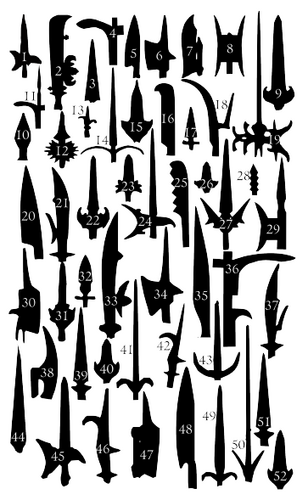
Quite simply, the whole zine is three d100 tables you can use to make 1,000,000 unique polearms. Granted, most of these variants are completely cosmetic (one table is for the design of the blade and one describes the decoration on the shaft), but don't knock the cosmetic elements of this zine. The blade design table is 100 silhouettes of polearm blades, all illustrated by Luke Simonds. If you scan these silhouettes onto a computer, it's an incredible resource for giving out polearms that players can see and get really attached to.
I know that I'd be more attached to something like 36 or 50 than the generic idea of a polearm.

The table describing the shaft's appearance is a little more repetitive (a lot of different colors, a lot of different inlaid items), but again, being able to grab some descriptive inspiration for a magic item is great.

But it's the "What Makes It Special?" table that really makes this zine, well, special. 100 (mostly) very different abilities, some good, some bad, some ludicrous, but all very different than a +1 polearm. For example, you could get a polearm where the blade functions like a camera, or the shaft turns into a ladder, or it smells really bad, or it gives you the ability to command stags (but they'll seek revenge afterwards). There's really something there for everyone and every type of game, from the serious to the comedic to the gonzo.

It's a good zine Bob!

Wednesday, December 13, 2023

A System of Deliberate Violence

When attacking someone, gain +1 or -1 to the attack roll (your choice) for every applicable item from the following list:

  • You know their first name
  • You know their last name
  • You know their parents' names
  • You know their partner's/partners' name(s)
  • You have mutual friends
  • You have drawn their blood before
  • You have killed one of their species before
  • You studied their movements
  • You studied their anatomy
  • You had sex with them
  • You lived with them
For every applicable item, regardless of the effect on the attack roll, gain +1 damage.

June 2026 TTRPG Crowdfunding Retrospective

It's still July, so this isn't yet completely 100% late. That's a win in my book, so check out the raw data and dive in. June 2...