Showing posts with label review. Show all posts

Monday, June 24, 2024

Review: Haunted Heist

Cover of Haunted Heist by Daniel Carter-Hope and Paul Williams; a white stereotypical ghost runs with a bag of dollar bills spraying out behind them

What is it?

Haunted Heist is a game by Daniel Carter-Hope and Paul Williams of Red Mug Games, the games arm of the UK-based Evil Hypnotist Productions indie film studio. I was given a digital review copy of the game by Red Mug Games but have received no other compensation as part of the request to review it.

The pitch: players take on the role of deceased criminals under the guidance of a Game Medium (GM) to embark upon a heist that would otherwise be impossible by living human standards. The overall tone is comedy/horror.

The art communicates this endearing sort of horror atmosphere, akin to Disney's Haunted Mansion or The Nightmare Before Christmas, quite well, but unfortunately, as my players pointed out after we finished playing, the tones of the game clash discordantly at times. Some of the potential outcomes of actions (mostly the horrific and instantaneous death of unfortunate bystanders) really don't feel like they fit with what the game bills itself as. For example, one of the stronger abilities of the Possessor includes this detail: "Strong possibility the target will suffer a fatal stroke/heart attack/aneurysm when the possession ends." This is an awfully specific manner of death, one that has the potential to really upset some players given the relative prevalence of these health conditions in real life, and it's just not that funny either when it comes right down to it. Head exploding: high funny potential. Fatal aneurysm: less so. If you bring this game to the table, take the temperature of your players to understand what kind of bloody slapstick they have an appetite for.

How does it work?

Players have a resource called Spirit Level (SL) that they can spend on various spectral powers based on the type of ghost they are (Haunter, Poltergeist, Possessor). If they run out of SL, they vanish until the GM can reconnect with them. Action success is determined by rolling 2d6 and checking the table for the outcome (5-9 is a partial success, to give an idea of what to expect).

The GM's actions mainly involve predicting the result of dice rolls. When any player rolls for an Action, the GM predicts the outcome, and if they're correct they get a sizable benefit. Similarly, when it comes time to resummon ghosts, the ghost's player rolls a d6 and the GM predicts the result. If they're correct, the ghost returns with full SL, and if they're wrong they can try again next Turn with the ghost predicting their own number.

The game also operates on a ticking clock, with the GM keeping track of Turns in each Round with a 6-sided die. Every ghost gets one action per Turn, the Round advances after 6 Turns. The more time you take, the more likely the heist is to end in failure with the ghosts abandoning their jobs to take care of Unfinished Business or the GM's Debt causing their grisly demise.

How did it go?

I played this game with a group of three players about a week ago using the "End of the Pier" adventure summary from the book itself: "Magic isn't real... or is it? Down-on-his-luck hypnotist Derek Beige has the whole town under his thrall, but for what nefarious purpose?" With this summary, I spun up the Great Bosinski Game Medium, another 'psychic' conman who had been operating just fine in Mortecambe Bay until Derek Beige showed up. Using the spirits of Gem "Knock" _____, Spinnin' Sid, and Frozen Freddie, we were all set up to steal Derek Beige's platinum pocketwatch and break his terrible power.

It was right here, shortly after character creation, that everything started to go off the rails. And not in the fun heist way.

What happened?

Let me be clear: much of this was my fault. In my revision of the rules before starting, I missed the instructions to organize the game in three phases: Character Manifestation, Planning, and Heist. As a result, I skipped the Planning Phase and had the players jump into exploring the town as they tried to figure out how to take down Derek Beige. As a result, scenes were not so much pulse-pounding heist action as they were pulse-neutral information gathering, it was unclear when abilities could be used effectively, and everyone (including myself) left the game feeling a little frustrated.

A compounding factor on top of the initial error had to do with pacing. The game operates on a ticking clock in theory, but in practice we didn't even get all the way through a single Round. My players took about 2 hours to do character creation and play 5 Turns (15 actions), at the end of which we felt like we had just about resolved the problem of Derek Beige. This meant that we took an average of about 24 minutes per Turn and 8 minutes per action, which feels pretty fast for many storygames. But even so the game didn't feel particularly urgent or that we were on a time limit. This probably would have been mitigated with an actual Planning Phase as the players would have known more or less where they were heading.

Stuff I liked

Before going to the larger lessons learned here, I wanted to share bits and bobs that I particularly liked from the game:
  • I like the positioning of the GM as a player in the world and the explicit ticking clock that triggers certain events, and I really loved the thematic resonance of trying to psychically predict dice outcomes
  • The sample characters and their accompanying art give a good sense of the tone the game wants to live in: comedically gruesome and pretty absurd
  • The Grave Consequences table, while not always giving the most actionable or impactful results, has a clear voice with a dry sense of humor that is pretty fun and funny to read
  • Heist locations are all evocative and feel quite different from each other, but I would appreciate a better sense for how some of them would actually be used in a heist

So what do you do when you play a game wrong?

I'm not really sure, honestly. I only found my mistake in the rules upon rereading the text in preparation for writing this review. If I had just brought this game to the table because I thought it was fun, I probably would have just written it off after it didn't really work in play and never given it another thought. This speaks to a challenge that game designers face when working on their art: how do you ensure that something important doesn't get missed when people are learning how to play?

Ignoring the reality that you can never be 100% sure of this, one solution is to integrate the most important components throughout the rules. It's easy to miss a single reference to something important (as I did with the Planning Phase), it's harder to miss multiple references to a specific component that all feed into each other. These could be in the text of other rules, play examples, flowcharts, you name it; the important thing is that anything that is crucial to understanding how to play the game should be as inescapable as possible.

That is ultimately my biggest criticism of this game: its component parts don't quite gel together into the most harmonious whole. My experience playing it was frustrating, but that was partially due to one specific mistake I made before the game even started. I had an okay time playing, but neither I nor my players ever really found a groove where the game just worked for us.

Will I play this game again? Probably not. Will I be thinking about my favorite parts of the game (GM as diegetic character, ticking clock, psychically predicting dice)? Absolutely.

Saturday, May 11, 2024

It's (Not) Dangerous to Go Alone: Death of the Author

Welcome to the (much delayed) second entry in It's (Not) Dangerous To Go Alone, my ongoing series about playing and critiquing solo TTRPGs!

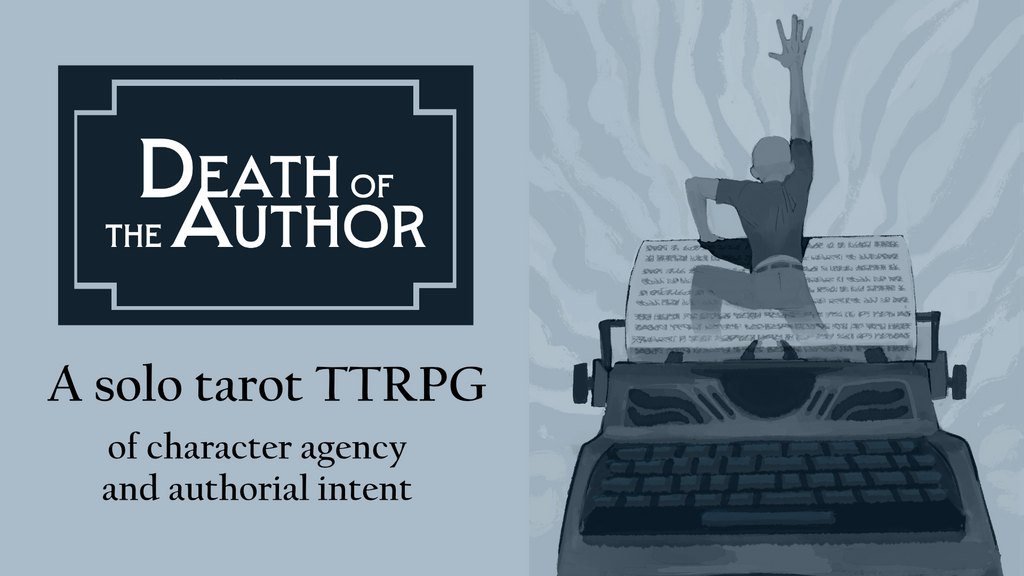
 A person crawling out of a typewriter, their hand outstretched. Text on the image reads: "Death of the Author; A solo tarot TTRPG of character agency and authorial intent"

When Samantha Leigh reached out to ask if I wanted to review their latest game, Death of the Author, I was an immediate and enthusiastic yes. I love solo games, I really admire Samantha's work, and the premise of the game was fascinating: a game about "a Character who attempts to gain control over their story, despite the wishes of their Author." Compelling stuff!

So I sat down with a Necronomicon deck of tarot cards that a friend gave me this past Christmas and about an hour later I had played through all five chapters of the game. I created a Character so obsessed with avoiding death that they began manipulating cancer cells to achieve eternal life, a Friend who betrayed me after seeing what I planned to do to their ailing great-uncle, and a Foe who tried to stall my research in undergrad and continued to stalk me even after their initial failure.

But the most interesting outcome was how the confrontation with the Author went. Throughout the game, your Character has the ability to change their story by altering the tarot cards drawn during various scenes, each time drawing the attention and ire of the Author. The Author retaliates by drawing Major Arcana cards, trying to steal your victory from you by altering the story to subvert your desires. But in my game, the Author was not an all-powerful force of nature; he was a puddle of nerves, afraid of where his own story was going and uncomfortable with what was being revealed about himself by him writing it. His interjections into the story weren't in the form of acts of God but warnings to the Character about pursuing this path, pleas to turn back, feeble attempts to dissuade them from their research. In the end, the Character stood over their Author, barely even sparing them a glance before walking out of the story (and beyond their influence) forever. They did not achieve their original goal, but they had still essentially defeated their creator.

Now a large part of this outcome depended on the deck of tarot cards I was using, and not just the value of the cards that were drawn. As I said, this was a Necronomicon-themed deck filled with Lovecraftian monstrosities, so the genre and tone of the game was basically set from the jump. On top of that, all the Major Arcana cards represented fears of some sort (fear of death, of madness, and of science being the Character, Friend, and Foe cards respectively), so the Author that the deck conjured up did not feel like a godlike figure of power but rather a sniveling puke of a man afraid of his story, his characters, and what they said about him. How to square this, then, with a game that is supposed to be about fighting for control?

A spread of 10 tarot cards from the Necronomicon tarot deck
The deck is quite horrific but set the scene beautifully.

Well it can't be. Not really. Because this game is less about fighting against a malicious tyrant trying to force you to conform than it is about bracing yourself against the relentless onslaught of the tyranny of chance. As Cezar Capacle recently pointed out in a post about how to make our cognitive biases work for us, we're wired to find patterns in a set of random data and create stories to explain it. It's arguably how reading tarot works in the first place, and it's the basic function of any solo game with a randomizer. This story might have an Author, but that Author is subject to the rules of the game the same as the Character is. More, even, as the Character always has the player on their side; the tenor of the Author depends largely on the cards you draw, which are then open to interpretation and pattern-creation by the player. The Author you end up with is the Author that you create to fit the story you're in, not the other way round.

Any misfortune that happens in this game is created by random chance and what the player brings to the table rather than by someone with their own ideas about what your Character should be doing. You could almost say that this game is a better simulation of real life than it is a character in a story since things tend to actually happen for a reason in stories (even if those reasons aren't necessarily nice or good). In this game, the characters and Author alike are swept along by the whims of the tarot deck, with only the player to steer the ship through the treacherous waters.

The cover of the movie Kapten Ahab (2007) featuring a weathered white man in dark clothes staring into the middle distance on a sailing ship
Pictured: your average Death of the Author player.

So does the game deliver on its premise? Are you playing "a Character who attempts to gain control over their story, despite the wishes of their Author"? Well, yes and no. The prompts in the early access version of the game that I played almost leave too much open to interpretation and don't try to force the Character in the direction that the Author wants enough. Indeed, it's never set out what exactly it is that the Author wants for the Character in the first place. I rarely felt like I was butting up against invisible walls or the dreaded railroad of the authoritarian GM. But in the end I had a fascinating relationship with my Author that probably couldn't have happened with a more heavy-handed approach to the game!

My best advice to people interested in this game:

  • The Author is only as rough as you make them, so if you want the experience promised by the game you've got to be willing to get in the mud and put your Character through it.
  • The tarot deck you use is going to influence you more than you might think, so be careful what you pick. I know that my next playthrough will probably be with my Mystical Cat deck and I'm sure that experience will be wildly different.
  • Don't let the cognitive biases get you down; put them to work and enjoy the ride.


Death of the Author comes to Backerkit on May 14.

Friday, January 19, 2024

Review: Cats Have No Lord double feature

A Tomb of Twins

Sometime mid-December, Luke Simonds posted on Bluesky asking if anyone was interested in reviewing two of his games (A Tomb of Twins and Won't Someone Think of the d100 Polearms?) as he had extra physical copies of them. I said I would, he sent them off, and now here we are about a month later.

Full disclosure: these reviews are based solely off reading the zines. I have not had the opportunity to put them into play, so interpret my opinions accordingly.

A Tomb of Twins

A Tomb of Twins is a 32-page (counting the covers) low-level dungeon zine for OSR games with writing and layout by Luke Simonds, art and map by Molomoot, and editing by Allison Miller Simonds.
 
A mysterious priesthood conducts monthly rituals inside the tomb of twin necromancers while rumors abound that great treasures and wealth is locked up inside. The twist is that the treasures in question (or at least the ones that the adventure hooks center around) are the phylacteries of the twin necromancers-turned-liches, while the monthly ritual keeps them from reforming and terrorizing the region.

The tomb itself is broadly twin-themed, with mirrored left and right sides of the dungeon presenting players a choice of where to go. A band of tunneling swampkin (blue humanoids who live in a nearby swamp) have entered one side of the tomb and pose an obstacle to the PC tomb robbers as well as a way to break up two otherwise identical routes.

From a design perspective, this adventure works well as an introduction to OSR-type play for new players. There's a dungeon, treasure, some inventive traps that can be circumvented with clever play, a puzzle, monstrous enemies, and a boss battle that can either be avoided or easily decimate the characters. Nothing here is really reinventing the wheel, but it also doesn't have to. The whole adventure could be completed in 1-2 sessions, and depending on how the crawl goes there is the potential for a number of further directions:
  • Accidentally release 1-2 liches
  • Make enemies/allies of the swampkin
  • Make enemies/allies of the Thieves Assembly or Arcane Academy for failing/succeeding to bring them the vials
My favorite part of the adventure has to be its take on the random encounter. The tomb traps spirits inside it, so it's positively full to bursting with ghosts. And not just ghosts of humanoids either, there's all sorts of ghostly vermin scurrying around to add a fun atmosphere to the whole thing. These vermin could pop up as random encounters, but more frequent an intelligent ghost will appear with their own motivation and information to share (or hoard). There are wizard ghosts who want to get to the center of the tomb with you, priests who want to keep you from advancing, and goblins who just want to cause pranks. This is a slight combination of the classic random encounter + reaction roll, but it works really well as a way to spice up the delve. You can't treat every ghost the same, and you have to approach them like any other NPC in order to suss out how they feel about you.

I have two primary critiques of the adventure. First, as I said above, it doesn't feel like it's doing much that's new. I know that I said it doesn't have to, and I stand by that, but there's a lot of design space that feels unexplored here. The two halves of the dungeon didn't have to be identical, for example. They could have been themed to each of the two necromancers, or have opposite versions of the other's traps/puzzles, or require various actions to be taken exactly simultaneously. I'm not trying to say "Well this is how I would have designed it," but the overall theming of the adventure just feels like it's begging to be taken one or two steps farther.

My second critique hinges on the swampkin. They add variety to the adventure, breaking into the left half of the tomb and keeping it from being exactly the same. This is fine, and two of the first swampkin you meet pose interesting roleplaying challenges. One is floating on the ceiling, having triggered an antigravity trap and willing to give information in return for help, and the other is described as kind-hearted and fascinated by humans. These are great moments but they're completely undercut by the bestiary's description of swampkin as "ruthless and indiscriminate killers." It just leaves a bad taste in my mouth to play into the portrayal of monstrous humanoids as intrinsically savage (perhaps not evil, but certainly violent and not prone to diplomacy). And the adventure itself doesn't bear this out! The two swampkin priestesses have opposing views on their expedition into the tomb, the warlord is insecure about his position and just wants a win to shore up support, and that one grunt just wants to get off the ceiling. The stereotypical "hyper-violent monstrous humanoids" just didn't need to be in the adventure at all and seems like an archaic holdover from early dungeon-crawling games. It would be more interesting to explore how both the swampkin and players are tomb robbers, and therefore have both a natural common cause and common conflict. This is already a sensibility reflected in the random ghost encounters, where the ghost is turned from a standard combat encounter with a monster into a variety of other things. Obviously nothing is stopping you from approaching the swampkin in the same way, but if that's the case I just don't understand the description in the bestiary. Much like my first point of critique, the swampkin feel like they're begging to be pushed just a little farther beyond the standard (and boring) 'savage' enemies.

If you're looking for a game to introduce players to the OSR, this is a fine choice. But if you're already familiar with the playstyle, I don't know how much will be here for you.

Won't Someone Think of the d100 Polearms?

Won't Someone Think of the d100 Polearms? is a 16-page (counting covers) system-neutral zine for crafting your own unique polearms with writing and layout by Luke Simonds, character illustrations by Evlyn Moreau, and editing by Allison Miller Simonds.

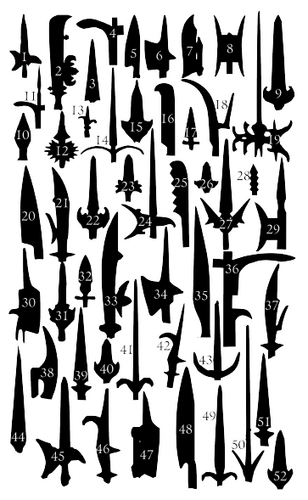
Quite simply, the whole zine is three d100 tables you can use to make 1,000,000 unique polearms. Granted, most of these variants are completely cosmetic (one table is for the design of the blade and one describes the decoration on the shaft), but don't knock the cosmetic elements of this zine. The blade design table is 100 silhouettes of polearm blades, all illustrated by Luke Simonds. If you scan these silhouettes onto a computer, it's an incredible resource for giving out polearms that players can see and get really attached to.
I know that I'd be more attached to something like 36 or 50 than the generic idea of a polearm.

The table describing the shaft's appearance is a little more repetitive (a lot of different colors, a lot of different inlaid items), but again, being able to grab some descriptive inspiration for a magic item is great.

But it's the "What Makes It Special?" table that really makes this zine, well, special. 100 (mostly) very different abilities, some good, some bad, some ludicrous, but all very different than a +1 polearm. For example, you could get a polearm where the blade functions like a camera, or the shaft turns into a ladder, or it smells really bad, or it gives you the ability to command stags (but they'll seek revenge afterwards). There's really something there for everyone and every type of game, from the serious to the comedic to the gonzo.

It's a good zine Bob!

Sunday, November 19, 2023

RPG Zine Club October review (part 2)

The Corrupted by Navaar Seik-Jackson

The Corrupted by Navaar Seik-Jackson is the adventure game offering of October's Zine Club, but I don't know if I would necessarily call it an "adventure game" if it weren't marketed as such. For me, an adventure should spend most of its time in specifics: maps, NPCs, factions, timelines, antagonists, things that a GM can easily reference and use at the table. In this zine, half of the 32 pages are devoted to the Protagonist System (the engine upon which this game runs), 6 detail game-specific GM advice/mechanics, and 9 deal with the world of The Corrupted. Already, this offering is in a bit of a weird place, but let's spend some time with the provided system to see what it has to offer.

The Protagonist System, per the designer, "draws from traditional systems like Dungeons & Dragons, as well as narrative frameworks like Powered by the Apocalypse games." The influences of these are obvious:
  • Use of a d20 for action resolution
  • Hit points
  • Skill lists
  • 6-10 second combat turns
  • 6 statistics
  • Partial successes/failures
  • GM moves
This system is used to explore a post-apocalyptic world (though it offers several flavors of how "post" the apocalypse it is) where an alien pathogen has infected much of life on Earth to create the titular Corrupted, blood-zombies that use inky tendrils to seek out iron-rich deposits and create new Corrupted.

A screenshot from World of Warcraft showing a few player characters standing among a sea of skeletons
Picture something like the Corrupted Blood Incident from World of Warcraft, except if all these skeletons were blood monsters.

I have...mixed feelings about this offering, but I'll start with what is good.

The Good Stuff

The two best parts of the system are:

1. Integration of mixed successes into combat via the damage your attack deals is genuinely very clever. Regular damage on a success (16-19 after modifiers), double damage on a critical (20+), and half damage on a partial success (10-15). It matters what kind of approach you take in combat, as with the right bonuses and some lucky rolling you can minimize the number of failures you get (and completely eliminate the possibility of critical failures, since you have to get a 1 or lower after modifiers). This makes the characters feel competent and well-suited for tasks they are specialized for, but also makes for some difficult decisions should they attempt untrained skills.

2. Threat Points make it easy for the GM to run encounters. They start with a budget based on the number of enemies in a combat, gain more when players roll badly, and spend them to do enemy actions like moving, attacking, or making changes to the environment. Under ideal circumstances, the enemies have a limited range of actions, but bad rolls generate additional Threat Points for the GM to use. This can have a cascading effect within a round, where a bad roll puts a character in a desperate position, the new Threat Points worsen the situation, and everyone else has to decide how best to deal with this. Under other circumstances, this could lead to a death spiral for the whole combat, but Threat Points reset each round. A terrible position at the end of one round of combat is still bad for the players at the start of the next, but the enemies are back at square 0 in terms of their ability to react. Yes, this is up to the randomization effect of dice, but smart approaches and playing to characters' strengths allows them to minimize the damage. 

These two parts combined angle the game experience towards highly specialized characters performing surgically precise actions (but otherwise acting fairly desperately) or more general-use characters that operate at a constant low level of risk but rarely in dire straits. These general modes of play feel very true to zombie apocalypse media in general: you either have average folks do their best in a horrific situation or military-level agents wasting enemies in combat but oftentimes struggling to accomplish more social goals like community-building. I would love to play a character of either type.

The...Less Good Stuff

The rest of the system (and zine in general) get in the way of what is good about it. What I reference above are not the only good things in the system, but it could be stripped down to those parts and some connective tissue and work pretty well. There are a lot of components of the rules that I would prefer to just jettison because I see them as adding more cognitive load to everyone at the table than the return I would get from them.

But beyond the specific rules that I might not like, the biggest problem that I have here is that the system gets in the way of my understanding the world of The Corrupted. As I mentioned at the top, there are 9 pages of setting information: 4 pages of bestiary (encompassing 4 types of enemies) and 5 pages on 4 factions you might encounter.

And that's it.

This is just not enough for me to grab onto to run a game in this world! I'm increasingly turning to game texts for details that I couldn't come up with myself, things that can inspire me to create my own stories in a world. And to be clear, the seeds of that are here in this zine. The Corrupted have some really fascinating details (they're searching for sources of iron, they develop and evolve over time, they might be aliens) but it's just not enough. Even the factions presented are fairly basic versions of zombie apocalypse tropes. You've got:
  • The troubled community doing its best
  • The people trying to figure out what caused the apocalypse and how to fix it
  • The evil corporation
  • And the paramilitary freaks
Just based off these tropes, I could come up with a lot of the text (or something approximating it) for these factions. But I'll tell you what's there that is really useful...

The Best Stuff

...the Day Zero, One Year, and Five Year timelines!

The "Running the Game" section introduces the idea of these three distinct 'timelines' you can run a game in, each of them featuring different themes, types/amounts of enemies, amount of salvageable material in buildings, that kind of stuff. Day Zero is hectic and chaotic but with plenty of resources available, Year One has clear factions forming and supplies running low, and Year Five has desperation on your heels and formidable foes around every corner.

This is exactly what I want from an adventure: actionable advice that helps me quickly and easily figure out what I need to get a game up and running. I just wish there were more of it, as what we have is pretty good. Each faction contains a brief writeup of what they look like in each timeline, but there's just so much more that could have been done and more specifics that could have been included (a roster of NPCs and how they change over time, for example). As it is, the game provides enough to play through each of these timelines, but you'll have to fill in a lot of the gaps yourself without too much help from the zine itself.

Wrap-Up

As I said in the previous review, I'm not in the business of giving out numerical scores at the end of these, so here's my final take on the game: this game could be good for the kind of play that I like to engage in, but it doesn't bring enough innovative ideas to the table for me to really want to use it. The influence of The Last of Us is clear and explicitly namechecked in the opening pages, but unfortunately, I'm just not sure how much this game has to offer beyond that.

Thursday, November 9, 2023

RPG Zine Club October review (Part 1): SuperDillin Double Feature

While attending Big Bad Con 2023 at the end of September, I had the opportunity to sign up for Plus One Exp's RPG Zine Club. This subscription service delivers 1-2 zines (both storygames and adventures) to your door/inbox each month, featuring a wide variety of creators and bringing together artists from around the world. Once I heard about it, I knew I had to sign up, both to build my personal hoard of RPG zines and to see what kind of interesting new games I might find as a result. This is a review of the storygame offering, with the adventure game review to follow in Part 2

SuperDillin Double Feature

The words "SCIENCE FICTION DOUBLE FEATURE" are written in a red, dripping font against a black background. Beneath them, a mouth with very red lips bites the bottom lip in a seductive fashion.
Just pretend that says "SuperDillin" instead of "Science Fiction"

Guys in Chairs

Guys in Chairs belongs to the "improv game" school of TTRPGs, a term I have completely made up to describe games that could be pretty easily found in an improv group's rehearsal repertoire. These are relatively simple games guided by strong premises and heavily dependent on players' ability to play off of each other in open-ended scenes. Here, you're playing the not-even-sidekicks of various super individuals (think less Robin and more Alfred) as they try to help their superfriends resolve various significant missions.

The title card for the 1973 "Super Friends" cartoon. Superman, Batman, Robin, Wonder Woman, and Aquaman stand in the center against a rainbow background. To the left is Wonder Dog, a gray dog in a green cape. To the right are Wendy and Marvin, a teenaged boy and girl.
These are your friends, and that's you on either end. Yes, you could be Wonder Dog, who's just a regular dog with a cape on.

The rules are simple (simple enough that I won't reproduce them here for fear of giving away most of them for free), but there is some structure lacking that could help players. Anyone not comfortable with improv or unfamiliar with the role of non-superpowered individuals in comic books might flounder a bit in this game. There isn't much in the way of advice in terms of the kinds of conflicts that you might encounter or how you can introduce meaningful action when you're a mundane character in a superpowered world. In short, this is a great game if you're already pretty familiar with roleplaying and comic books, but it doesn't have the scaffolding to help players new to TTRPGs.

Spin the Bottle

Spin the Bottle is the other half of the SuperDillin double feature, a system based on the kissing game of the same name. This is a very clever idea, to take the emotional weight and connotations of an existing object and convert them into an engine to generate those same vibes. This game centers around secrets: you have a crush (determined randomly at the beginning of the game), but no one else can find out. You spin the bottle to decide who your scene partner will be, but even when you're not in a scene you're constantly on the lookout for clues to other players' crushes. The game itself ends when someone correctly guesses another player's crush, so you have an additional reason to pay close attention to every scene.

Erin and Jamie, two characters from the webcomic Girls With Slingshots, talking to each other. Erin: "And you call yourself a Romance Detective." Jamie: "Heh. Well yeah, I got my magnifying glass and everything!"
Characters from Girls With Slingshots by Danielle Corsetto


This game presents more scaffolding and clearer goals for players, making it easier for them to understand how to set scenes and engage with each other. I particularly like the push and pull of trying to connect with other characters while trying to avoid giving away anything about your true intentions. The stakes aren't that high, so players are unlikely to feel truly antagonistic, but it does nicely replicate the strange sensation of being in a highly visible social setting where it feels like everyone is looking at you. Check out this game if for no other reason than to be able to say that you've actually played "Spin the Bottle."

The Verdict

I don't know how exactly I'm going to wrap up these reviews, but I know that I won't be using a score system. No stars, no */10, no tomato-meter, nothing like that. (For an excellent perspective on review scores, check out this blogpost by Spencer Campbell of Gila RPGs.) Instead, an attempt to wrap up my thoughts and give broad takeaways. So here goes:

I probably wouldn't have bought this zine if it hadn't been part of Zine Club. The games just aren't really my thing, and that's coming from someone who would gladly do Guys in Chairs as an improv comedy game. I prefer a bit more structure and scaffolding in games, some more inspiration as to the kinds of characters or scenarios you could work with. My view of game texts has morphed over time to prioritize games that can give me the idea to do something I wouldn't otherwise have thought of myself. And here, using Spin the Bottle as a way of determining scene partners genuinely does that! But the rest of the game doesn't quite support me in helping figure out what happens next. These games are great prompts for players who feel comfortable spinning up full yarns without so much as touching a resolution mechanic, so if that sounds like you I wholeheartedly recommend you check them out.

September 2026 TTRPG Crowdfunding Retrospective

This month I discovered that at some point around June, Kickstarter had added a new category to its searchable elements: TTRPG. Previously, ...